Alongside Gonzalez-Torres I have been given a handful of artists to research including
- Gillian Wearing
- Thomas Kilpper
- Mark Jenkins
- Leo Fitzmaurice
- Richard Woods
- Richard Wilson
- Manfred Pernice
I also want to do some further research into Dadaism which I researched during college :)
- Felix González-torres.
He was known for his quiet, minimal installations and sculptures. Using materials such as strings of light bulbs, clocks, stacks of paper, or wrapped sweets, his work is sometimes considered a reflection of his experience with AIDS. In 1987 he joined Group Material, a New York-based group of artists whose intention was to work collaboratively, adhering to principles of cultural activism and community education. Along with the other members of the group González-Torres was invited by the MATRIX Gallery at the Berkeley Art Museum and Pacific Film Archive in 1989 to deal with the subject of AIDS.
González-Torres was considered within his time to be a process artist due to the nature of his 'removable' installations by which the process is a key feature to the installation. Many of his installations invite the viewer to take a piece of the work with them: a series of works allow viewers to take packaged candies from a pile in the corner of an exhibition space and, in so doing, contribute to the slow disappearance of the sculpture over the course of the exhibition. In 1989 González-Torres presented Untitled (Memorial Day Weekend (1) and Untitled (Veterans Day Sale (2), exhibited together as Untitled (Monuments): block-like stacks of paper printed with content related to his private life, from which the viewer is invited to take a sheet. Rather than constituting a solid, immovable monument, the stacks can be dispersed, depleted, and renewed over time.[9] Untitled (1991), however, is a unique stack of 161 signed and numbered silkscreens that remain together. Similar to the 1989 billboard commemorating the 20th anniversary of the Stonewall Rebellion, its iteration as a stack of prints was meant, as the artist noted at the time, as a “more private and personal object”—one that is not disseminated physically but instead through the experience of remembering. The stark black page and white typeface on each sheet trace a nonlinear chronology of significant events in the history of the gay-rights movement.


The most pervasive reading of González-Torres's work takes the processes his works undergo (light bulbs expiring, piles of sweets dispersing, etc.) as metaphor for the process of dying. However, many have seen the works also representing the continuation of life with the possibility of regeneration (replacing bulbs, replenishing stacks or sweets).
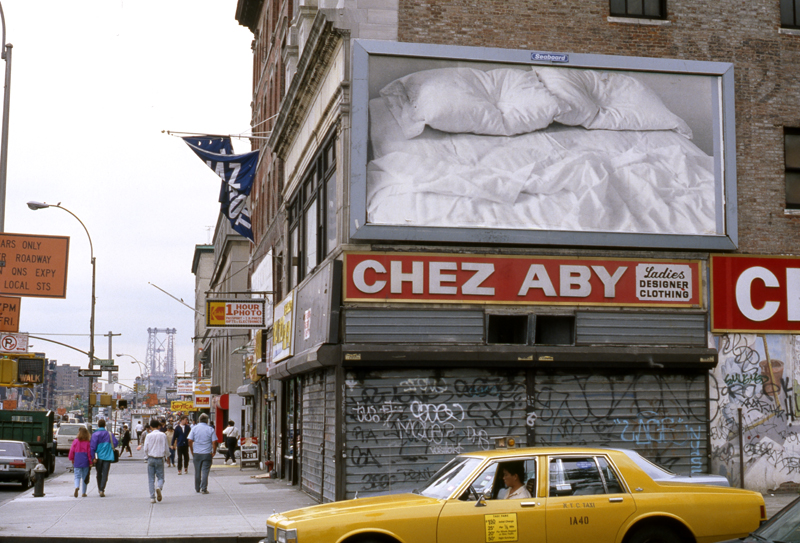
Other readings include the issue of public versus private, identity, and participation in contemporary art. One of his most recognizable works, Untitled (1991) seen at the top of this post, was a billboard installed in twenty-four locations throughout New York City of a monochrome photograph of an unoccupied bed, made after the death of his long-time partner, Ross Laycock, from AIDS. Also, Untitled (Placebo) (1991), in one installation, consisted of a six-by-twelve-foot carpet of shiny silver wrapped sweets. Like other sweet pieces in his oeuvre, the works have "ideal weights" which may fluctuate during the course of an exhibition. A borrower may choose to install the work at a weight different than the "ideal weight". The sweet pieces may also be installed in any formation the borrower desires.
In 1990 during Roni Horn’s solo exhibition at the Museum of Contemporary Art in Los Angeles, González-Torres encountered her sculpture Forms from the Gold Field (1980–82), two pounds of pure gold compressed into a luminous rectangular mat. When he met Horn in 1993, he created "Untitled" (Placebo – Landscape – for Roni (3) (1993), an endlessly replaceable candy spill of gold celophane–wrapped sweets. In 1992 González-Torres was granted a DAAD fellowship to work in Berlin, and in 1993 a fellowship from the National Endowment for the Arts.
All of González-Torres' works, with few exceptions, are entitled "Untitled" in quotation marks, sometimes followed by parenthetical title. (This was an intentional titling scheme by the artist).
In one interview, he said "When people ask me, 'Who is your public?' I say honestly, without skipping a beat, 'Ross.' The public was Ross. The rest of the people just come to the work."
González-Torres died in Miami in 1996 due to AIDS related complications.


No comments:
Post a Comment